Fast Exploration of Realistic Designs using Score-based Generative Models
Many engineering workflows require rapid generation of physically realistic designs, not just a single high-accuracy simulation. An example is porous-media transport. Here, there is a need for uncertainty quantification, design exploration, and real-time decision-making , settings where thousands of quick design realizations may be required, but full computational model is too slow to be used interactively.
The Problem
In our client's project, ion transport occurs through a battery (a heterogeneous porous medium) whose microscopic structure is not fully unraveled. This micro-scale uncertainty is modeled through a spatially varying porosity field $\varepsilon(x)$, which directly affects diffusivity, conductivity and the operating conditions of the battery. For a fixed set of macroscopic operating conditions, different realizations of $\varepsilon(x)$ lead to distinct solution fields for the ion concentration $c(x)$ and the electric potential $\varphi(x)$. Accurately capturing this variability is essential for realistic modeling, but solving the first-principles physics is generally too computationally.
The figure below shows the porosity field, ion concentration and potential and how they link to the macroscopic operating conditions.
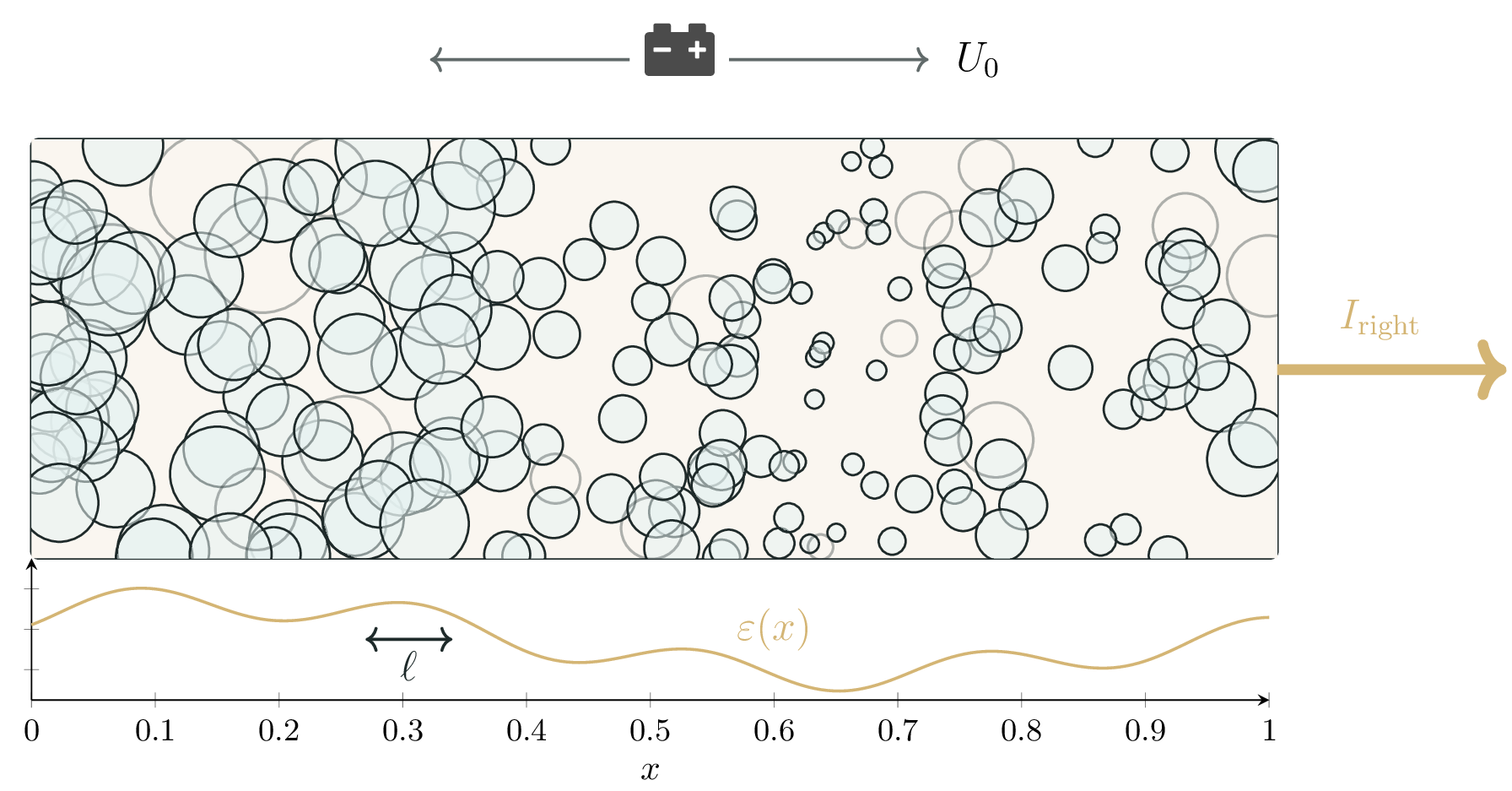
Combined, uncertainty is strongly influenced three main macroscopic conditioning parameters:
- Typical spatial scale $l$ of $\varepsilon(x)$
- Voltage $U_0$ applied over the battery
- Boundary current density $I_{\text{right}}$
For each choice of $(l, U_0, I_{\text{right}})$, there exists not a single solution, but a distribution of admissible solutions $(c(x), \varphi(x))$ arising from unresolved micro-scale structure.
Our Solution: Generative AI for real Industrial Applications
To efficiently model this conditional distribution, we turn to score-based generative models (SGMs), a class of probabilistic models originally developed for high-quality image generation. State-of-the-art technologies such as Stable Diffusion are built on SGMs. Rather than predicting one deterministic solution, SGMs learn how to sample full solution fields from the conditional distribution $$p\big(c(x), \varphi(x) \mid l, U_0, I_{\text{right}}\big),$$ to capture both physical trends and inherent variability. This is one of the first times that GenAI methods were used to solve real scientific and industrial needs - and we are extremely proud of this accomplishment.
Some more details: the model is trained on high-fidelity finite-volume simulations of the underlying physics,
where each training example consists of a solution pair $(c(x), \varphi(x))$ together with its associated conditioning parameters.
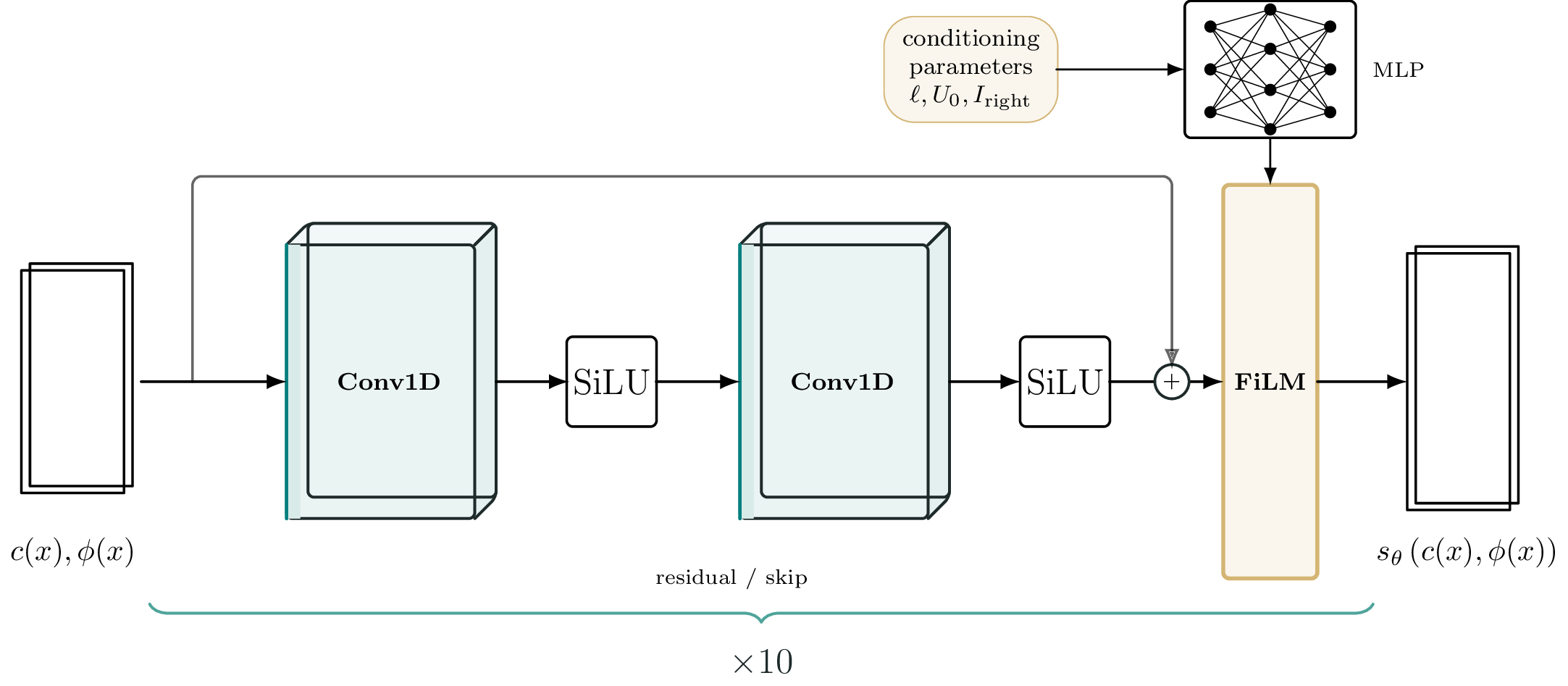
Spatial structure is handled by convolutional networks, while global parameters and time-like diffusion variables are injected through feature-wise modulation (FiLM).
The neural network architecture is displayed below.
The Result
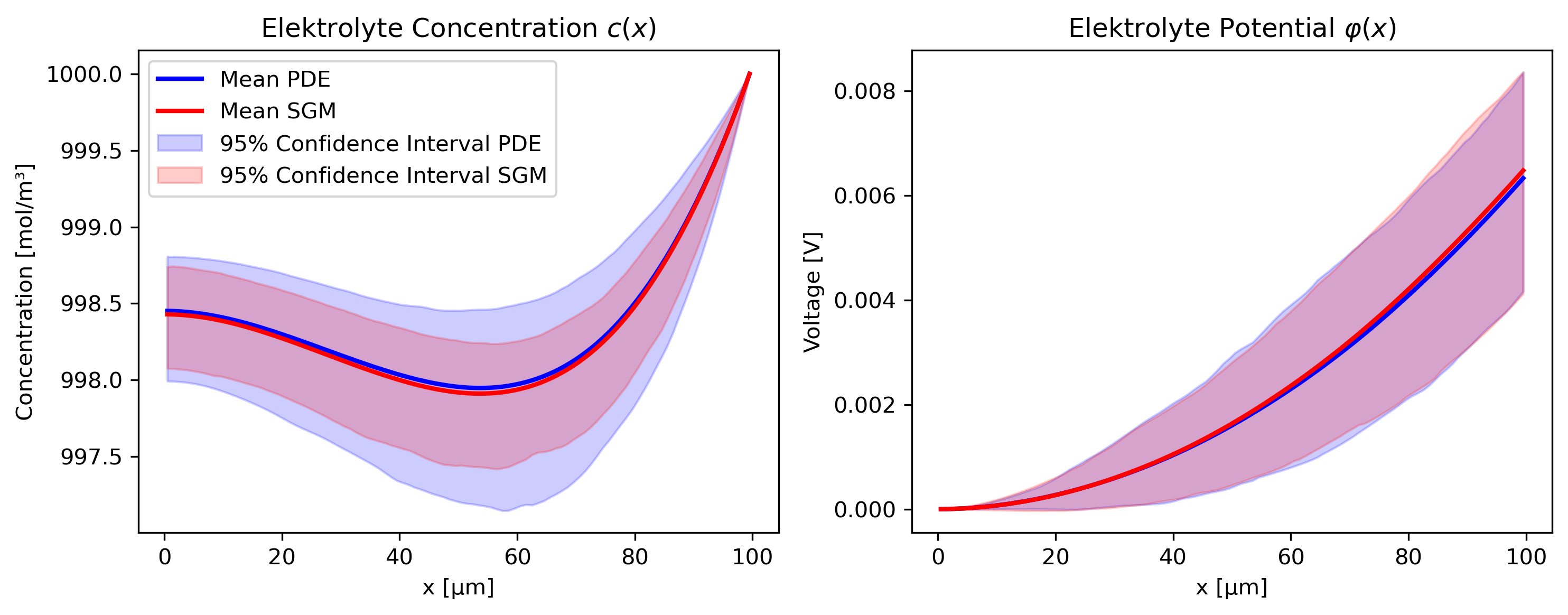
Once trained, the model produces diverse, physically plausible designs orders of magnitude faster than direct physics simulations.
Even more, our approach captures the uncertainty very well. The final figure shows the mean and 95% confidence interval of 500 realizations of the SGM
 This project demonstrates how generative AI can be used in scientific computing, offering a powerful new approach for fast design exploration!
Facing a similar bottleneck?
Book a free 30-minute consultation. Bring your slowest workflow and we'll tell you what we'd do about it.
Book a 30-minute consultation