Learning to Solve Elasticity Equations with Neural Operators
Structural simulations are essential in engineering and material science. From stress analysis in mechanical parts to predicting deformation in biomaterials, knowing how a material will deform under a load without doing the actual experiment can significantly speed up the design cycle. Traditional finite-element solvers are highly accurate but computationally expensive when simulating the same equations under many different loads material properties.
At Open Numerics, we've developed a Neural Operator (NO) that can instantly predict the complete material displacement under any applied stress. This approach bypasses the need to re-solve the PDE for each new input.
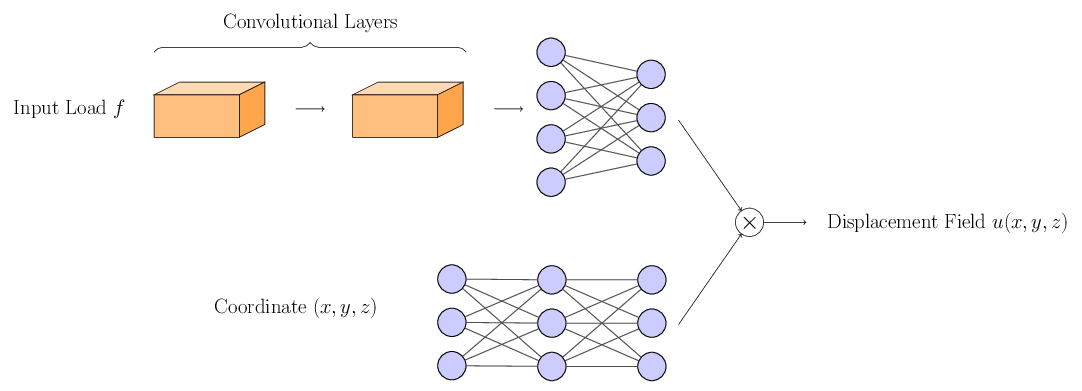
Our Neural Operator is based on a DeepONet architecture (see picture above) with additional convolutional layers in the branch network. Convolutions allow the branch to efficiently encode spatial patterns in the input load. The trunk network learns a compact representation of spatial locations, enabling rapid evaluation of the displacement field over the whole domain.
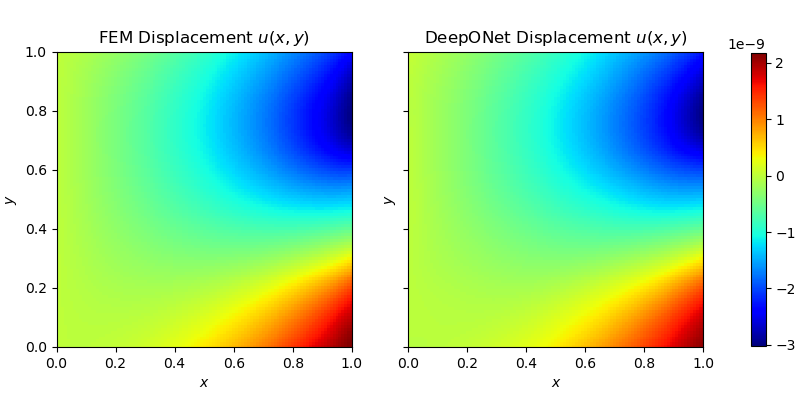
Our model generalizes across a wide class of input forces, producing accurate predictions at a fraction of the computational cost of standard solvers. The comparison below illustrates how the neural operator matches the accuracy of traditional FEM while delivering results orders of magnitude faster. This makes it ideal for real-time simulation, optimization, and uncertainty quantification tasks.
This model is currently being used to determine the maximal stress loads of new materials multiple times a day. It allows researchers to speed up the simulation part of the design cycle more than 10x. We deployed this model on our client's servers and implement regular updates.
Facing a similar bottleneck?
Book a free 30-minute consultation. Bring your slowest workflow and we'll tell you what we'd do about it.
Book a 30-minute consultation