Advanced PDE-Constrained Control of Chemical Reactors
The Problem
Modern chemical reactors operate at the intersection of heat transfer, fluid flow, and complex reaction kinetics. These physical and chemical processes are tightly coupled and highly nonlinear, meaning that small changes in operating conditions - inlet composition, temperature, or catalyst placement - can propagate through the reactor and lead to large variations in conversion, yield, energy consumption, and profitability.
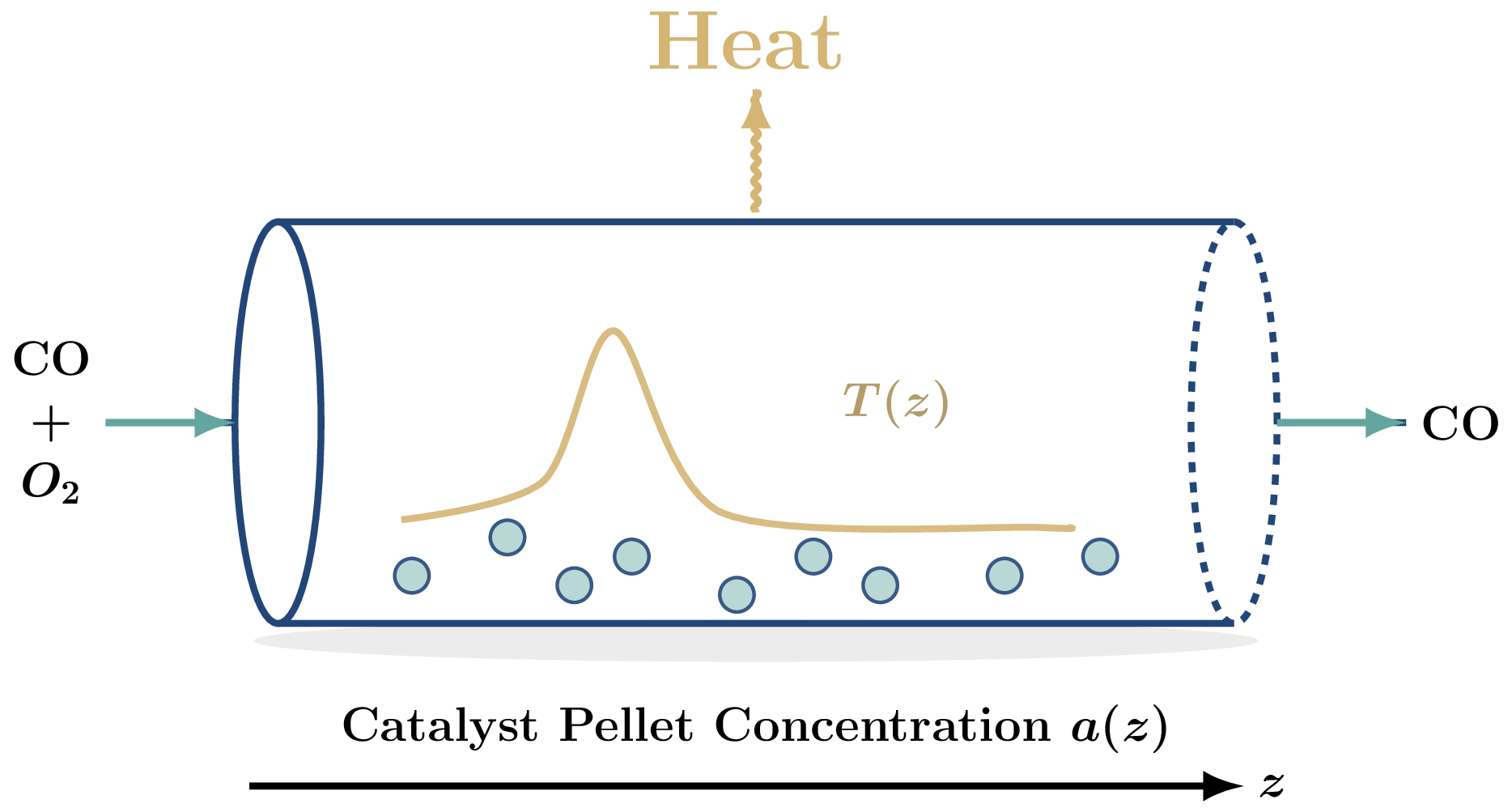
One of our clients operates a gaseous carbon monoxide (CO) to oxygen (O₂) reactor, where catalyst pellets aid in CO conversion. Despite stable inlet conditions, they faced seemingly random temperature spikes that damaged the reactor and incurred a high cost of repair and downtime. The underlying challenge was a familiar one in reactor engineering: maximize the conversion yield while avoid thermal spikes and damage.
Exothermic reactions amplify this difficulty. Heat released by the reaction can accumulate locally, degrading catalyst beds, shortening reactor lifetime, or in extreme cases triggering runaway behavior. Achieving high performance without compromising safety requires deliberate, physics-aware control, and existing controllers were not up to the task.
This is precisely where our expertise adds value.
Our Approach
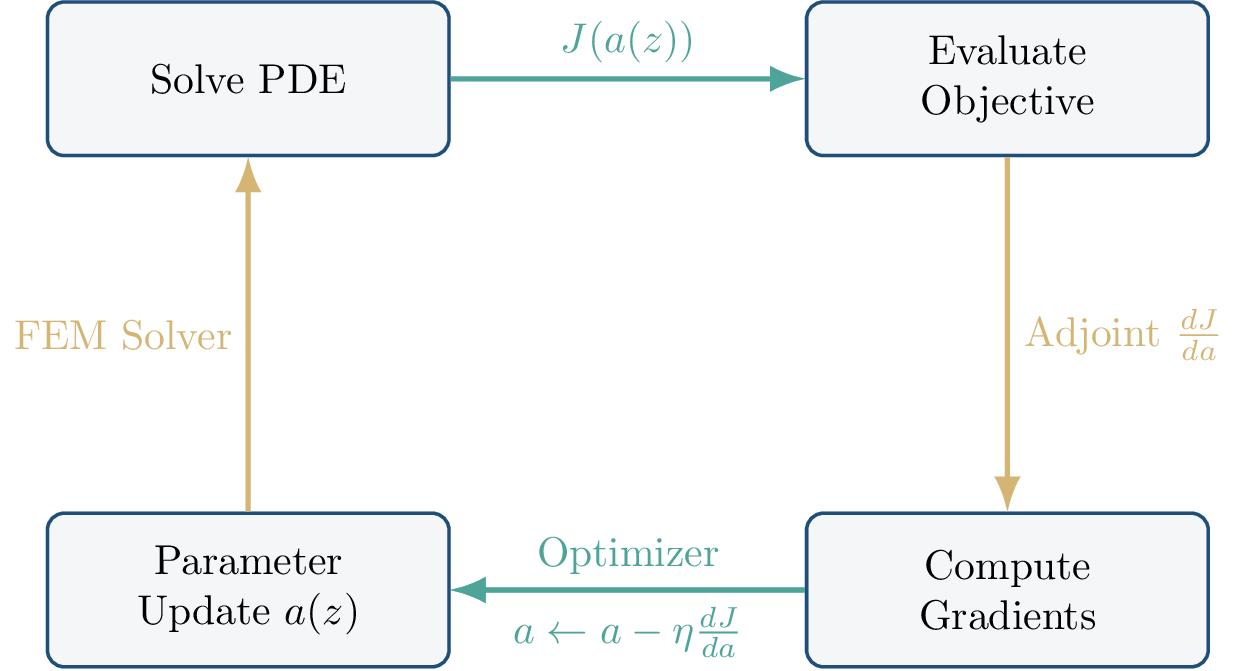
We built a custom controller that maximizes CO conversion while deliberately keeping the reactor away from runaway conditions. From a first-principles point of view, we decided to optimize the objective $$\min_{a} J(a) = -\frac{\mathrm{CO}_{\text{out}}}{\mathrm{CO}_{\text{in}}} \;+\; \gamma \int \max(T(z) - T_{\text{in}}, 0)\, dz. $$ The first term measures the yield and the second term keeps the reactor away from thermal runaway. By identifying the catalyst concentration $a(z)$ as the primary design variable, we gained direct control over both performance and stability. The resulting temperature and species profiles are predicted using first-principles differential equations, which we embed directly into the control design. This physics-aware, PDE-constrained optimization approach keeps the reactor operating at peak efficiency while respecting strict safety margins. Figure 2 summarizes the physics-aware control loop.
The Result
In summary, our approach combines high-fidelity physics with cutting-edge optimization techniques. The result are operating conditions that are optimal, physically interpretable, robust to uncertainty, and fully aligned with engineering safety limits.
We have been able to eliminate thermal spikes altogether. As a bonus, the total yield has also increased from 17% to 44%. For clients, this means safer operation, higher yield, larger profit margins, and the ability to explore design and control strategies digitally - before ever touching the reactor.
Facing a similar bottleneck?
Book a free 30-minute consultation. Bring your slowest workflow and we'll tell you what we'd do about it.
Book a 30-minute consultation